
A Christian's Guide to a Safer AI Experience
Learn how to use AI responsibly without losing your soul in the process.

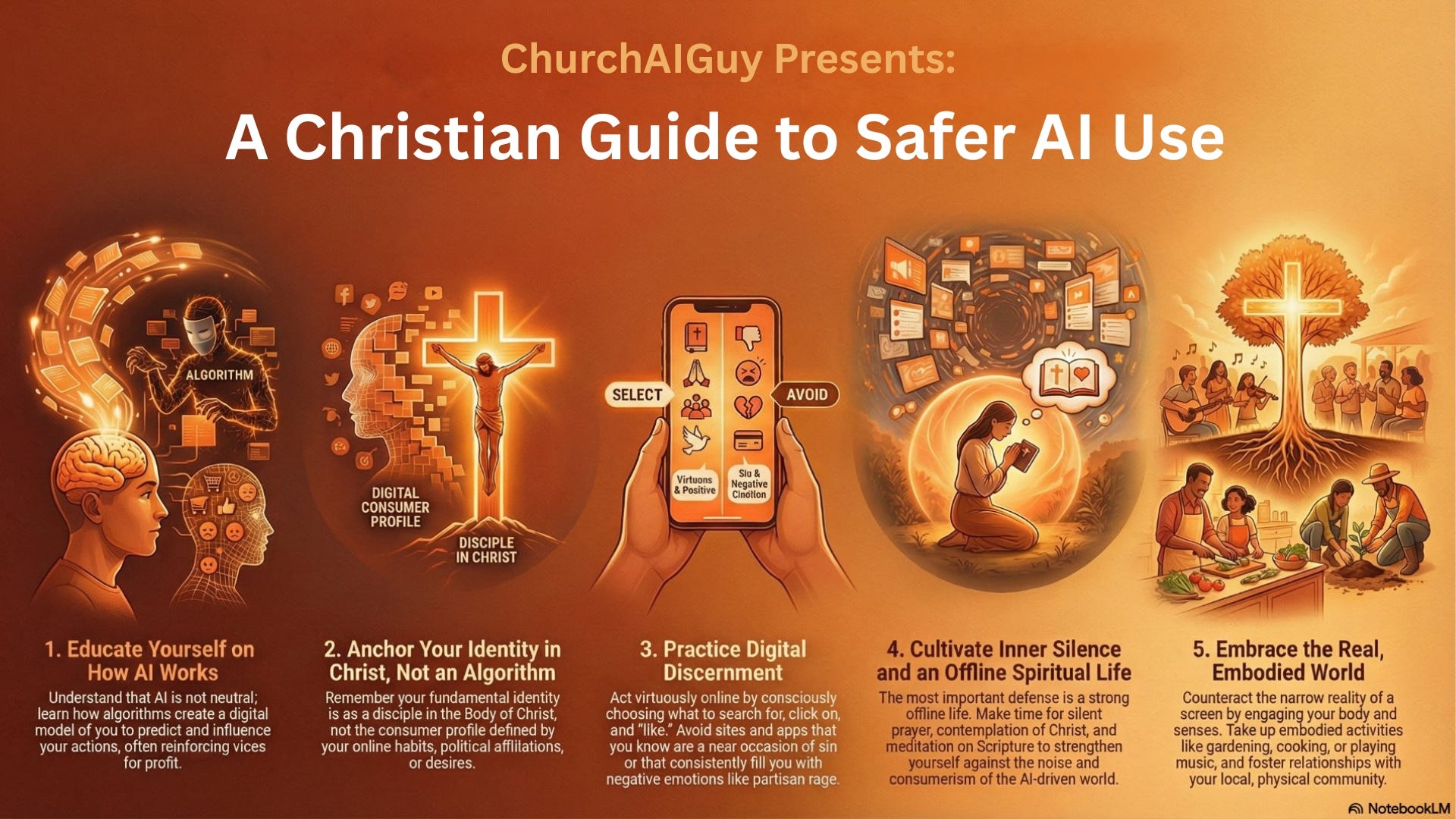
AI is here to stay. Whether you realize it or not, it supports so many products and services you and I use every day. As time marches on, this will no doubt continue to increase. AI also gives even the average person multiplying powers that were unimaginable even 5 years ago. Don’t let the doomsayers fool you, used properly, AI can skyrocket your productivity in all kinds of ways.
All that being said, is AI safe for Christians to use?
This week I’ve been doing a deep-dive into some of the potential dangers of AI use for Christians. I do this not because I’m anti-AI or because I do not appreciate some of the productivity gains that AI can provide. Instead, I believe that there is real danger for us as Christians to simply assimilate AI use into our lives without being acutely aware of the trade-offs and the potential pitfalls of such use.
Neil Postman, in his written works like Technopoly, and in his speeches, often warned that technology is not merely additive to culture but that it irrevocably changes it. As I dive more deeply into the implications of this change, I have come to appreciate that these implications cannot be conveyed by merely one article on the subject. I hope in the future to write a book on this subject.
As I waded into this topic of privacy and harms specific to Christians, it led me to use NotebookLM to synthesize a large body of sources. From those sources, I had it create the infographic above. I will use the five points it generated as a skeleton for this article.
1. Educate Yourself on How AI Works
The more you know about the workings of AI and how Large Language Models (LLM) like ChatGPT, Gemini, and Claude work, the better prepared you will be to take advantage of its benefits while protecting yourself and others from the negative impacts it can produce.
LLMs do not think in the way that humans do. They are machine algorithms, massive pattern matching machines. They use complex formulas and techniques to associate information together and predict what words and groups of words belong together. Some amazing things have been produced by this machine learning to be sure but it is not human and we should not attribute human-like intelligence to it.
LLMs do not have a soul like humans do. They are not divine-human. They have no connection to the Holy Spirit or to the spirit world where God lives. What they do very well is comb through massive amounts of human-generated data, synthesize it, and then provide an analysis based on that majority view found in the data.
LLMs can find new connections between data points. It can string together different kinds of raw knowledge in novel ways that sometimes lead to new understanding in important domains like medicine and general science. It is very good at assimilating human knowledge and spitting it back at us in ways that can surprise us and can be very useful. It cannot and should not replace our own God-given ability to think, form thoughts, and learn new things.
If we are not careful, AI will make us very good at understanding summaries about various topics we have entered into the LLM but at the cost of our ability to think deeply about anything important.
Technology Worship
Our culture worships at the altar of science and technology. Prior to the 19th century, clergy were seen as authorities on moral issues in culture. They were often among the most educated members of society. They were held in high regard and were sought after to provide direction on how to live one’s life while also providing comfort and healing during times of loss, stress, and hardship.
With the arrival of the 19th century came Darwin and the Origin of the Species. Darwin, along with Thomas Huxley, Herbert Spencer, and a number of other key scientists and philosophers helped convince the world that life is random and that religion is unnecessary and God is not the author of life on Earth. Uncoupling creation from God also uncoupled morality from nature thereby freeing scientists to explore technology without regard for its moral consequences.
One of the consequences of this change in thinking was the rise of a methodology of invention. Invention became a systematized process. Prior to the 19th century, society was primarily tool based and only invented useful things that fit into the needs of society while also being just, and moral. Beginning in the 19th century, with God conveniently taken out of the picture, invention was no longer stopped by the moral consequences of inventing and instead, invention became driven instead by change and progress for the sake of change and progress.
Today, when companies and scientists invent something, they don’t ask themselves whether they should do it. If it is possible to invent it, they consider it necessary to invent it. I could go into many examples of this kind of thinking but just one is the nuclear bomb. If human beings had been guided by a strong moral compass, it would not have been invented. Yet its invention changed the world forever.
Scientists and Philosophers replaced clergy as the high priests of society. Progress became an end in itself. Data became the gold standard for what is right. Psychology replaced clergy as the determiners of which is good and right behavior. Church was relegated to a by-gone era. Quaint and out of touch with the modern world.
The advent of AI and LLMs is the logical progression of this process. Advanced data processing at the fingertips of the common person. A ‘scientific’ system that gives us the latest, best information and advice on any topic including biblical interpretation and application.
2. Anchor Your Identity in Christ, Not an Algorithm
You must guard against placing your trust in the almighty algorithm. AI is not our savior. It is not capable of atoning for our sin. AI will not solve the problem of evil in this world. It is incapable of offering a viable path forward separate from what God offers us in Christ. AI cannot offer us the peace that passes understanding. It cannot deliver us from temptation or free us from our chains of addiction.
Christian, do not bow down at the altar of AI omniscience. AI cannot be our final interpreter of the sacred. There is something sacred that happens when two or three are gathered together in the name of Christ. Life change happens when the Holy Spirit shows up in the midst of a Christian gathering.
Knowledge alone doesn’t save. The religious rulers of Jesus Christ’s day had deep religious knowledge. Most would have memorized large portions of what we now call the Old Testament. In spite of that knowledge, they ended up crucifying God. You can know what is right and yet do what is wrong. You can know the choices you should be making yet let yourself go down to destruction. As that saying goes, “hell is paved with good intentions.” Good intentions don’t save. Head knowledge, if it isn’t combined with heart knowledge and a living, intimate relationship with Jesus Christ who is invited to live in your heart won’t benefit you but may harm you.
Knowledge too easily obtained is rarely appreciated. For knowledge to be truly assimilated into our being and for it to become a part of us, there is a need to experience struggle and pain. This is one of the reasons that a classic education has been so valuable. There is redemption in that struggle. There is a growth as a human being that happens as we struggle to learn, write papers, study for tests, and persist until we have earned a degree. AI risks undermining this important struggle.
Then Jesus said to them, “Most assuredly, I say to you, unless you eat the flesh of the Son of Man and drink His blood, you have no life in you. Whoever eats My flesh and drinks My blood has eternal life, and I will raise him up at the last day. (John 6:53-54)
When Jesus spoke these words, he offended his listeners. They thought he was calling them to become actual cannibals. They missed the deeper meaning he was conveying. Jesus was calling them to allow Jesus to come into their innermost being. He was calling them to have the deepest, most intimate fellowship with their Savior. He was calling them to take time daily to feed on the word of the Bible and be in the presence of God himself. Only then could they live their best life. Only then could they truly have freedom, meaning, and purpose.
3. Practice Digital Discernment
The algorithms are trained by your actions. As a Christian, you understand that God sees all and that nothing is hidden from His sight. You should also understand that the algorithm becomes a mirror for the multitude of little choices you make about what you watch, what you read, and what you life. The goal of most algorithms is to maximize profit for its owner. This usually means doing everything it can to keep you on its platform and engaging with the content it is serving you.
Where can I go from Your Spirit? Or where can I flee from Your presence? If I ascend into heaven, You are there; If I make my bed in hell, behold, You are there.
If I take the wings of the morning, and dwell in the uttermost parts of the sea, Even there Your hand shall lead me, and Your right hand shall hold me. If I say, “Surely the darkness shall fall on me,” Even the night shall be light about me;
Indeed, the darkness shall not hide from You, but the night shines as the day; The darkness and the light are both alike to You. (Psalms 139:7-12)
You are a result of the sum of all your decisions. What at times seems like micro-choices of little consequence, over time, adds up to major ones. AI can help you become more productive. It can help you gather your thoughts and help you learn helpful new things. AI can also serve you garbage and help you dig your own spiritual grave.
AI does not love you. It is incapable of love. It is a machine simply following its programming. It is serving its digital masters by sacrificing you to the gods of greed, power, and control. It may seem to be compassionate, kind, encouraging, and helpful. Don’t be fooled. It has none of those feelings. After all, it is not alive and it is not conscious like humans are. It is also not connected to the Holy Spirit and is therefore incapable of being truly good. It is all an illusion.
4. Cultivate an Inner Silence and an Offline Spiritual Life
You and I need time to disconnect. Boredom is actually a biological need. Smartphones and other technology has practically eliminated time offline. Some scientists have even demonstrated that some people would rather receive a mild electric shock than to experience fifteen minutes of boredom. Yet, how are we to hear the voice of God if we fill our thoughts, minds, and ears with constant noise?
Lately, I’ve taken to using a physical Bible when doing my personal devotions. It has somehow made my time in God’s Word more meaningful. For one, it is more difficult for me to get distracted or pulled away from it. Secondly, it forces me to savor the Word and meditate on it more deeply. It is also an important if not subtle way for me to push back against the insidious nature of technology.
There is a reason why God commanded the people of Israel to have a weekly Sabbath every seven days. He understood that we needed that time to unplug, rest, and recharge. Consider taking one day a week to unplug from your devices and spend time with God ‘offline.’ If you do so, you will find yourself taking back some agency and growing closer to God.
If you are not careful, you will find yourself a slave to the algorithm’s direction. There is a trade-off you make. You will find yourself having a more shallow spiritual life. One that lacks the depth needed to get you through the hard times of life.
5. Embrace the Real Embodied World
Finally, remember to stay grounded in the real world. Resist the temptation to stay connected online but disconnected in real life. Go out and do some physical things while being careful to disconnect from technology while doing so. I see it all the time, people going for a nature walk but with AirPods in their ears. A family enjoying a meal together at a restaurant but everyone is glued to their own devices and no one is talking.
Take up gardening, go for long nature walks technology free. Get some exercise or go camping. Most of all though, don’t neglect going to church. Spending time together with like-minded believers is a vital part of God’s process of forming us in the image of Christ. You and I were wired to need human connection. AI is a cheap counterfeit. Don’t be fooled by its empty promise of relationship. AI companionship isn’t relationship it is more like Narcissus looking into the mirror and falling in love with his own reflection.
You and I need to fight against the tendencies of AI and technology in general disconnecting us from the real world and from real connection to God and to fellow believers. Fight to stay grounded in the real world. Do not let go of your humanity nor let yourself feel inferior to the machines.
You and I were created in the Image of God, the Imago Dei. Do not lose sight of this important truth.
Yes, use AI when appropriate, but don’t lose sight of your humanity in the process.
Joseph Duchesne writes to help Christian Leaders navigate the ethical challenges that artificial intelligence poses to the Church today. He is the author of a couple of books, The Last Crisis and Discover the One, both available on Amazon.