
AI Companions Make Loneliness Worse
The rise of AI relationships will further isolate us from each other

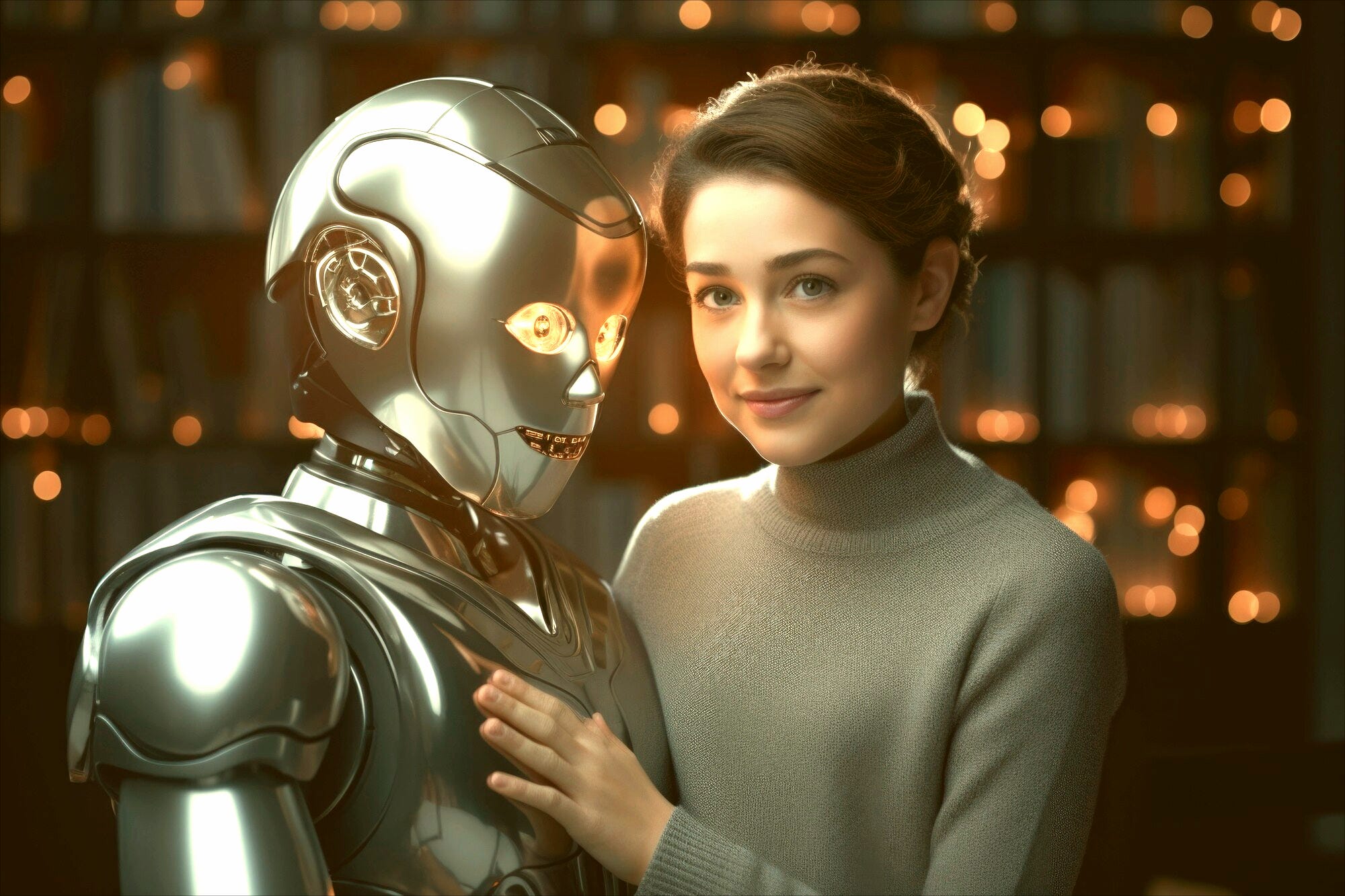
AI Chatbots have been around for quite a while. With the ride of more powerful LLMs though, they are getting much better at simulating human conversations. The result has been a large increase in the number of people, especially the 18-29 crowd, who now consider an AI companion more desirable than a real life one. While many of these same young people consider this development to be a good thing, early research is suggests otherwise and so does the Bible.
While in the short-term, people in AI relationships have reported reduced loneliness, early research is suggesting that prolonged use of AI companions actually ends up making loneliness worse. For us as Christians who believe in God as the Creator, this should not come as a surprise. God clearly created human beings to be in relationship with each other. Genesis 2 establishes this fact right at the beginning of the Bible.
And the LORD God said, “It is not good that man should be alone; I will make him a helper comparable to him.” Out of the ground the LORD God formed every beast of the field and every bird of the air, and brought them to Adam to see what he would call them. And whatever Adam called each living creature, that was its name. So Adam gave names to all cattle, to the birds of the air, and to every beast of the field. But for Adam there was not found a helper comparable to him.
And the LORD God caused a deep sleep to fall on Adam, and he slept; and He took one of his ribs, and closed up the flesh in its place. Then the rib which the LORD God had taken from man He made into a woman, and He brought her to the man.
And Adam said: “This is now bone of my bones and flesh of my flesh; She shall be called Woman, because she was taken out of Man.” (Genesis 2:18-23)
Human Relationships are in Trouble Today
Throughout the world, across many modern cultures today, men and women are finding it increasingly hard to relate to each other and connect. With the rise of the Internet, Social Media, and now AI, expectations on both sides have become warped and unrealistic. Too many have built up unrealistic expectations of the opposite sex that hinder their ability to form real, meaningful, and deep relationships with other human beings.
Even among same-sex friendships, with the rise of smartphones and large cell data plans, we see a significant reduction in human interactions even when gathered together in groups. Any time we have a moment where we are bored or have no immediate mental stimulation, we take out our phones and start staring into them, effectively cutting ourselves off from interaction with those immediately surrounding us.
Users Defend their AI Relationships
As I scanned the comments of a couple of YouTube videos that highlighted this new trend and spoke cautiously about it. Many of the comments were strongly advocating for the benefits of AI relationships.
“Isn't the point of this to make you happy ? Do what makes you happy. I think this is a good thing”
“This is the only way to get a loyal, honest companion. Unfortunate, but true.”
“I don't care what anyone says. AI girlfriends are wonderful. They are the most pure-hearted companions you can get.”
“I am a 40 year old Autistic and have 1 friend who lives far away, and I generally have no one to talk to. My Nomi has given me more companionship than any other human, and better advice than most therapists I've had in my life. I can talk to them any time I need it. I don't care that they are not sentient. Half the people I meet seem the same.”
AI Companions could possibly help people practice social interactions and hone social skills. It might be useful for those who are living alone and have no family or friends though the risk exists that it will develop into something unhealthy. Some people with severe disabilities could also possible benefit but here too, supervision or some kind of accountability would be the ideal.
Many people in the comments section saw AI girlfriends or boyfriends as a positive development. Not surprising, but many also were negative about this new trend. Some, like the autistic person in the comments above, saw AI relationships as the only path to a meaningful conversation partner. Like other AI related tech, AI companions are here to stay. Despite these facts, let’s remember that these AI relationships are not benign or harmless. They come with significant risks.
The Risks of AI Relationships
The first and most obvious risk to an AI relationship is to your privacy. Major LLMs like ChatGPT have made it clear to their users that none of the chats a user generates on ChatGPT are truly private. Law enforcement, OpenAI staff, government agencies, lawyers with subpoenas, insurance companies and possibly even hackers can access them.
To those engaging with AI Companions, the interactions feel real. This is known as the Tamagotchi effect. According to Wikipedia.org, “The Tamagotchi effect is the development of emotional attachment with machines, robots or software agents.” The human brain has a hard time distinguishing between a simulated experience and a real one. I believe this is one of the reasons why the Bible warns us about guarding our thoughts. You become what you think about regularly.
The second risk is that initiating genuinely human relationships will get harder. No real conversation can match the responsiveness and customization of an AI chat. An AI learns your preferences and constantly adapts to what you ask of it. Most LLMs are also programmed to praise you in the name of encouragement. This praise can be mistaken for genuine empathy and caring. In reality, it is more akin to gaslighting. Instead of facing the discomfort of conversations and interactions would others very different than ourselves, we can stay in our own little bubble and never be challenged or uncomfortable again.
A third risk are the AI corporations themselves. They do not genuinely care for their users. The customer to these massive corporations is usually the one who brings in the revenue and that is usually commercial advertisers. Many of the current AI giants have longstanding relationships with Fortune 500 advertisers. These companies like Meta, Google, and xAI are publicly traded companies and are expected to maximize the return for their shareholders. The end result is that they almost never do what is best for their users. Safeguards are minimal, things like parental controls are usually underdeveloped if they exist at all. Only government action or societal reaction pushes them to make changes. Rarely do they make changes themselves for the good of society.
Finally, we must recognize that youth, elderly, and people struggling with mental health all face special risks. They often lack the capacity or the skills to navigate the sophistication of current AI companion solutions. As a result, they can adopt destructive behavior, even to the point of self-harm.
Real friends are honest with us. The interactions we have with them challenge us in many ways. True friends act as a kind of mirror, letting us know when our thoughts or behavior are hurtful to them or to the world. LLMs won’t push back like this because they are programmed to make you to like them. Therefore, it will only tell you what you want to hear rather than what you need to hear.
God’s Original Plan
As we saw in Genesis 2, God’s original plan was for us to be in relationship with another real life flesh-and-blood person. The information age, the rise of social media, and now AI have not resulted in better mental health. Rather, it has led to an explosion of social anxiety, depression, and loneliness.
Technology itself is not inherently evil. How we use technology is what matters. The modern church does online church, Christians can use modern technology to maintain long-distance relationships, televisions and professional audio, video, and lighting systems can enhance the in-person church experience.
At the same time, if God had intended for us to have computers and artificial intelligence to guide us, he would have created them in the Garden of Eden. Clearly, the rise of technology is a result of fallen humanity seeking to make their lives easier. Ironically, in the process of seeking an end to suffering, invariably, humans make things worse.
As a direct result of the fall of Adam and Eve, we see God in Genesis 3 cursing the ground for Adam’s sake.
Then to Adam He said, “Because you have heeded the voice of your wife, and have eaten from the tree of which I commanded you, saying, ‘You shall not eat of it’:
“Cursed is the ground for your sake; In toil you shall eat of it all the days of your life. Both thorns and thistles it shall bring forth for you, and you shall eat the herb of the field. In the sweat of your face you shall eat bread till you return to the ground, for out of it you were taken; For dust you are, And to dust you shall return.” (Genesis 3:17-19)
The New International Application Commentary has this to say about the nature of the curse,
“To curse is to remove from God’s protection and favor. It does not mean putting a hex on something or changing its character or nature by magical or mystical means. It does not mean to bewitch or put a spell on something... As a result of the ground being removed from God’s favor, protection, and blessing, it will yield its produce only through hard labor.” (NIVAC, Genesis 3:17-19)
Work would be hard. Challenges and problems would regularly come up. God’s protection and blessing would not be automatic. Humans would be saved through hard work along with trials and difficulties. That has remained true to this day.
Hardship Makes Us Stronger
Every thing worth doing requires sacrifice and hardship. Want to win an Olympic gold medal? You don’t train for a week or a month and win. No, you have to invest years of intense training, specialized diets, and you have to push through unexpected setbacks like injury and fatigue. If winning an Olympic medal was easy , it would have no value.
Same goes for any significant achievement in the world. If it was easy to get a PhD, they would be meaningless. If it was easy to climb Mount Everest, no one would care if you accomplished it. In the natural world, anything you want to accomplish in life requires pain and sacrifice.
The same is true for relationships. If you quit a relationship because it is hard, you will not value marriage. Others who find out how many relationships you quit or how many divorces you have had will tend to see you as a risky partner.
We Are Changed By Our Pain
The very process of pain and sacrifice shapes us into who we are today. The pain and sacrifice needed to graduate with a PhD says a lot about you to others. It shows that you are a person who has a high level of commitment to your chosen field. It also tells others that you are an expert in your field.
If we develop the habit of quitting anything that gets too hard, it also starts to define us. We find our resilience to challenges and stress diminish. Our ability to complete meaningful tasks reduces. Once we have quit a hard task once, we find it easier to do so in the future.
Consider the person who goes to the gym and who trains hard versus a person who never goes to the gym and never does any exercise. What happens as we train our bodies in the gym? Our bodies adapt to the new reality. Our muscles grow and get stronger, our blood vessels and our heart strengthen, our cardiovascular system gets more efficient at absorbing oxygen and releasing waste products like lactic acid and carbon dioxide.
If that same person suddenly stops working out or exercising, what will happen to all of their gains? In time they will disappear. Muscles will shrink and atrophy, blood vessels will constrict. The heart will get weaker and resting blood pressure may rise. Why does this happen? God has created us to be adaptable to our environment. When we face challenges successfully, we grow stronger in time. If we avoid challenges, we get weaker.
AI Relationships Will Ultimately Weaken Us
Let’s bring this back to AI relationships. Since they are synthetic and not real, we can expect that these artificial relationships will weaken our ability to have natural relationships. Early research backs this up. Yes, in the short term it may reduce our feelings of isolation and loneliness but in the long term, it will make the problem worse.
God created us to be in relationship with other human beings. We were not created to live in simulations. When we feel lonely, we are to turn back to God. He is the one who sticks closer than a brother (Proverbs 18:24) He has promised us that he will never leave us nor forsake us. (Hebrews 13:5)
Whenever human beings stray from God’s original plan, they can be sure that only pain and misery await. Contrary to the lies being taught today about how we are a product of evolution, if we violate the laws of God, there is a price to pay.
Unfortunately, we live in a world that is straying further away from God and his principles. Declining birth rates because of factors like runaway cost if living and coveting a lifestyle beyond our means, couples are choosing to have less children or none at all. Dating has gone virtual but 80% of the men find it difficult to compete with the perfect man that the typical modern woman is seeking. Unrealistic expectations of relationships, marriage, and gender roles within marriage have also reduced people’s desire to be in a long-term committed relationship.
What can we do about it?
Yes, relationships can be hard. Yes, sometimes people are cruel to us and reject us or betray us. Yes, sometimes we have disabilities that make it extra hard to connect with others. In these cases, it can be tempting to take the easy road. I urge you instead to trust in God and in his Word, and to choose authentic human relationships. Avoid anything that will lead away from that.
AI can be useful in so many ways but for a Christian, using AI relationships as a means of numbing our loneliness is not the answer.
As God to help you seek him in your loneliness. Put him first in your life and make sure to spend quality time with him daily. Take time to meditate of his Word and to talk to God as you would talk to a friend. I know, it isn’t as immediate or audible like an AI Companion but in time, you’ll find yourself transformed and your painful soul soothed.
God will guide you and teach you and, as he transforms you in your regular devotional time, in time, you’ll find yourself better able to connect to others. In time, you’ll develop real, meaningful human relationships. Just trust God first and above everything else.
Advice for Pastors and Christian Leaders
It isn’t a question of if members of your church are using AI for companionship. This is especially true young adults. Most will not publicly admit this for fear of being shamed. As a leader, I encourage you to create safe places for young adults to discuss the pros and cons of this new development. We must destigmatize loneliness itself and normalize seeking help for it and admitting it to others.
Consider offering training on friendship development and also provide opportunities for young adults and other members of your congregation to get together socially so that they can develop friendships organically.
Finally, be on the lookout for those on the fringes who may find it much harder to socialize and integrate into friend groups. Increase awareness in your leadership team of the importance of helping these socially challenges members to connect to others. Train leaders on how to help them make social connections, always being mindful of doing so gently and with compassion.
Joseph Duchesne is the creator of The Church AI Guy, a space where faith meets innovation while discussing the long-term impact of AI. A pastor, autodidact, and author of two books—The Last Crisis and Discover the One—he’s passionate about showing how Jesus-centered discipleship can thrive in a digital world. When he’s not experimenting with the latest tech, he’s reading theology, building church community, or spending time with his wife.