
How Christian Parents Can Safely Use AI for Family Devotions
Strengthen Family Devotions Without Compromising Your Faith


AI presents challenges to Christians today, no doubt about it. That being said, when used responsibly, AI can be used to help improve the quality of your family devotions if used responsibly and the risks are understood and avoided.
Large Language Models (LLMs) like ChatGPT, Claude, and Gemini can do some amazing things. They can also cause harm if not properly understood. In this post I’m not going to dwell on the harm so much. I have other posts that cover those.
Instead, I’m going to present some ideas a parent can use to generate or find that can lead to better engagement from your children while helping you as a family draw closer to each other and to God. Let’s dive in!
Quality Discussions
It can be very easy to read a simple devotional reading or a Bible text and that’s it. The whole thing can be over in under five minutes. Then comes a prayer and then comes bedtime.
I would strongly urge you to do more than that as a parent.
For your children to grow up to be men and women of faith, strong in their convictions and able to weather whatever storms life or the devil throw at them, they will need to be fed deeply and regularly at the family worship time.
A great way to go deeper is to ask questions to your children about what you have just read. Sometimes, it can be difficult to know what questions to ask. It can also be challenging if the children are different ages. This is where AI shines.
Ask your favorite LLM the following:
Generate four or five open-ended questions from the following text being careful to make them appropriate for [fill in the age of your kids here]:

[paste the text in the chat box immediately under this prompt.]
Don’t have the time to type in the text since it is in a book and not on your phone or computer? No problem! Simply click the paperclip or attach icon on your phone’s LLM app and take a picture of the page where the devotional you are reading is found.
The LLM will read the text from the picture, and deliver four or five age appropriate open-ended questions.
If you want to apply what you’ve read to your life in a practical way, you can ask the following follow up request of your LLM:
Give me an application question or two from this devotional that will help us as a family apply it to our daily life.
In seconds, you’ll have engaging questions that will help guide your family through the content of your day’s devotion without relying on any interpretation from the AI.
Creating Biblical Coloring Pages
In the not so distant past, if you wanted coloring pages or crafts, you had to go do a Google search and then scroll through websites trying to find an appropriate image or coloring book for your kids. Same when looking for appropriate crafts.
Now, using the image generation features of major LLMs like ChatGPT and Google’s Gemini, you can generate as many coloring pages or crafts as you like.
Here is a sample prompt:
Generate a letter sized coloring page of David and Goliath where David is facing the giant and is twirling his sling over his head while running towards him.
This is the output I got on the first time I used it in ChatGPT:
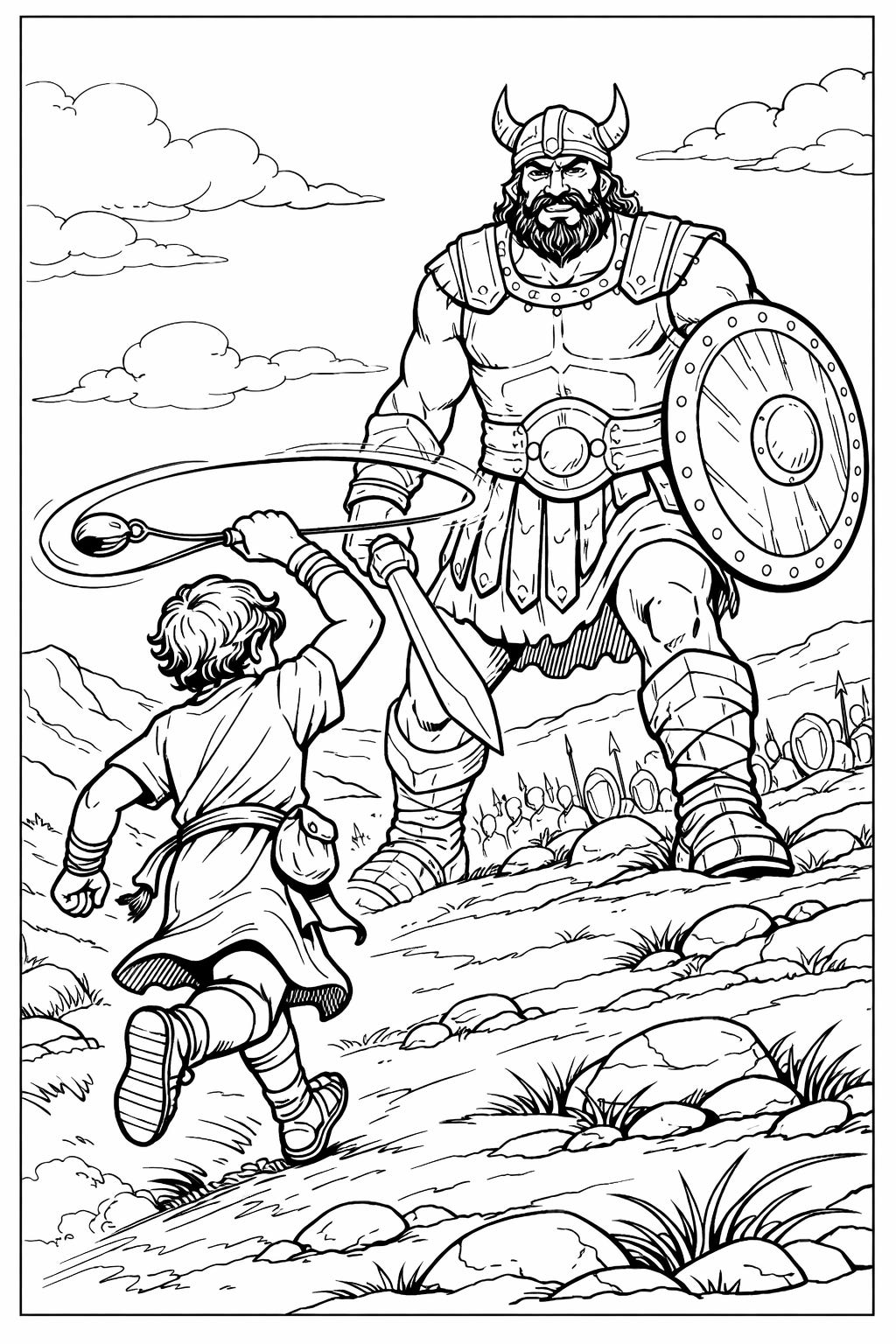
Pretty cool right? And super fast to do. If you don’t get what you want the first time, try to be as specific as you can be. Your imagination is the limit!
Creating Crafts
Getting your LLM to create crafts is more difficult than making coloring pages. With a bit of effort though, you can get it to produce something halfway decent though your results may vary.
My first attempt at creating a biblical craft using ChatGPT didn’t quite go as planned.
My sequence of prompts looked like this:
Generate a craft suitable for an 8 year old that is based on the Bible and features cut outs, needs to be cut out and colored and has accompanying instructions on how to complete the craft.
ChatGPT created a long set of instructions for the craft including materials needed, what is on the template and step by step instructions on how to complete the craft.
Unfortunately, it failed to generate the craft itself. I then tried to prompt it to create the print-ready template based on its suggestion at the end of its instructions.
While it had no trouble generating detailed instructions on how to cut out the craft, it comically failed at generating the craft itself. This one made me laugh:
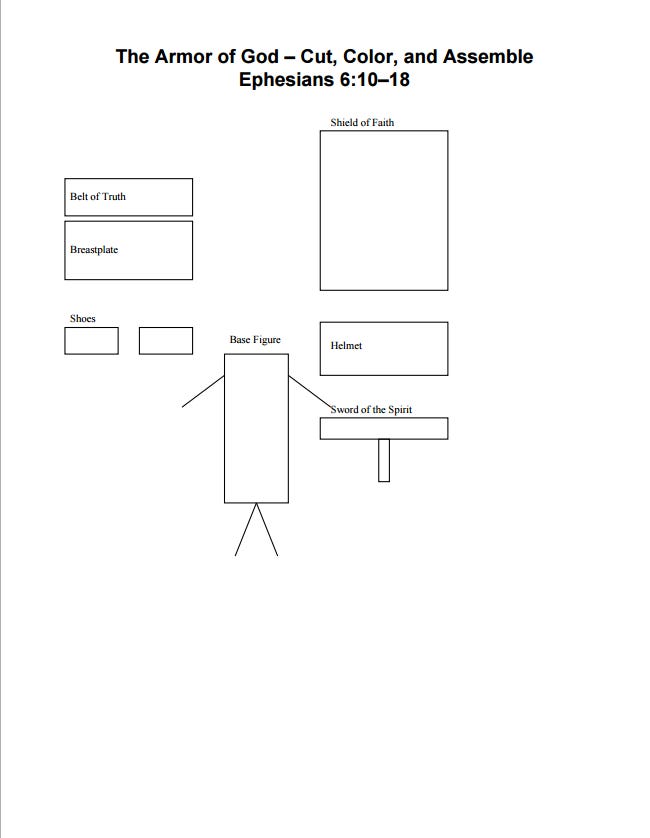
I had to prompt it a second time and this time, it did a fairly decent job at it. This is what it looked like after the second attempt:
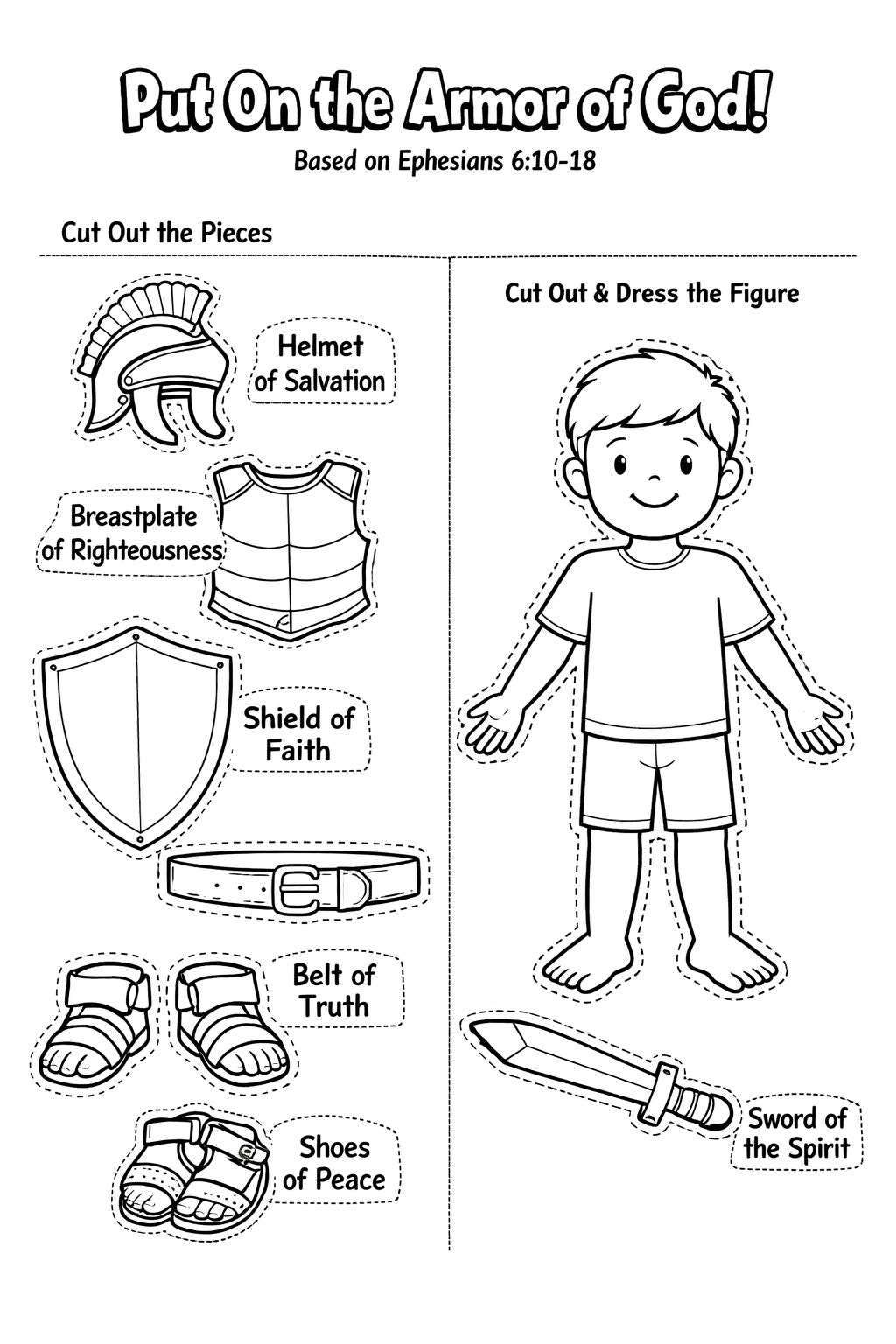
WARNING: I tried generating a craft using Claude, Grok, and Gemini. Claude did produce a decent craft but it used code to create the craft and its generated output kind of looked strange. Gemini created a print ready template but it looked smaller than a page so it would probably print small. Grok failed at generating any image.
For me, ChatGPT did the best out of all of them. I was using their free plan.
Generate a list of fun family activities
Finally, why not use your LLM to help you brainstorm a fun family activity you can all do? Sometimes routine gets boring. AI can help you break out of that boredom by doing something new together.
The best part? You can get the LLM to generate fun activities that are age appropriate AND that are on the same theme as your day’s devotion. For instance, I fed the following prompt into ChatGPT:
I’m looking for a fun Christian activity that is appropriate for a family of four with mom, dad, and children ages 7 and 9. Give me indoor activities that don’t cost any money but will help us have a good time spending time together. Make it on the theme of David and Goliath.
This is just one of the activities ChatGPT gave me. It generates six ideas, all of them were good.
SAMPLE ACTIVITY:
Living Room Slingshot Accuracy Game
Focus: God uses what seems small
How it works
Make a “target” using pillows, paper cups, or stuffed animals.
Use rolled socks as “stones.”
Set distances for kids vs. adults.
Each throw must be preceded by a truth like:
“I trust God.”
“God helps the small.”
“I don’t fight alone.”
Discussion question
Why didn’t David need armor like Saul?
(Answer you’re guiding toward: He trusted God, not appearances.)
Why Am I Posting Content Like This?
I have recently decided to shift the audience focus of this Substack. Don’t worry, I’ll still be featuring a number of posts on AI ethics and I will continue to be seeking to apply biblical morals and standards to our use of AI.
That being said, I also want to highlight the many ways that LLMs can be used for good. If you are a parent or a grand-parent, you may not have thought about using an LLM in this way. Hopefully, your mind has been expanded!
If you don’t have kids or grandkids, can I ask you to do me a favor? Send this post to someone who does!
NOTE: I will be creating posts, resources, and reviews for adults too. My goal is to show that while the risks of AI are real and should not be minimized, there are still positive things that AI can bring to our lives that are biblically sound and helpful.
Joseph Duchesne writes to help Christians navigate the ethical challenges that artificial intelligence poses to the Church today while also learning positive ways to use AI. He is the author of a couple of books, The Last Crisis and Discover the One, both available on Amazon.