
Raising Wise Kids in the Age of AI
How biblical discernment is the difference between a foolish child and a wise one.


A parent’s worst nightmare is a child who makes foolish decisions. I remember when my son was around 10 years old, after making a foolish decision and here I was having to discipline him, I had him read Proverbs 12:1.
Whoever loves instruction loves knowledge, but he who hates correction is stupid.
(Proverbs 12:1)
No one sets out to be stupid. No parent wants a stupid child. Yet, too few parents take the task of discipling their child seriously.
Screaming at your child isn’t discipling them.
Getting angry at their foolishness won’t help them grow.
To impart wisdom to your child, you first need to make sure she feels valued and wanted by you. Your child needs to know that you accept them and love them. Quality time with your child is a non-negotiable.
When you spend time with your child though, don’t make it only about mindless fun. You have an opportunity to teach and also to ask questions. You should be engaging their mind and helping them think through the big questions in life.
When your kid makes a mistake, how you respond to that mistake will make a big difference as to what they learn from that mistake. If you get angry every time they mess up do you realize what lesson you are teaching? Better hide my mistakes from mom, from dad.
Instead of responding with anger, respond with compassion, kindness, and understanding. Your job is to teach. The best way to teach is to start by asking questions. Good questions are a super power.
Everyone makes mistakes. No one does things perfectly the first time. I promise you, your child is not trying to mess up. When they do make mistakes, help them think through it, learn from it, and come up with new ideas on how to deal with the same challenge in the future.
Building Discernment in Your Child
I recently had Claude generate a document for me that it entitled, “Raising Wise Kids in the Age of AI.” The guide was created from a prompt I gave Claude. In that guide, Claude included a number of questions you can ask your child to help them think through the implications of AI use. Though AI generated, I was impressed with them so I thought I’d share them with you.
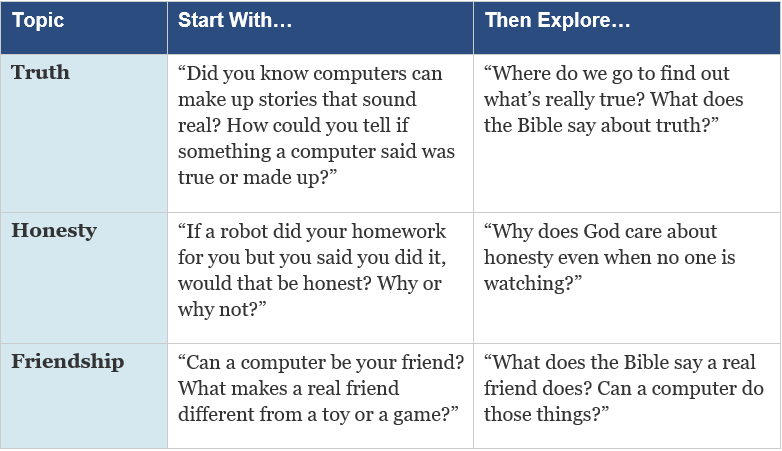
Notice how you ask the questions. These questions were targeted to children ages 6-10. You want to ask age appropriate questions that match the level of mental development of the child. The point is to teach them to think for themselves. At that age range, it is far too easy for a parent to impose their will on the child. While you may get obedience from them by doing that, it fails to teach them to think for themselves.
Help your child work through a problem by thinking his way through it. What are the implications of my decision? How does this align with that the Bible says about what is right and wrong? What can I learn from the mistake I just made?
Good Discernment Practices Are a Habit
You don’t teach discernment one time only. Discernment is a habit of thought. It is learned behavior. It comes through repetition. Don’t delegate the work of discipleship to others, not even your church. You are meant to disciple your child, no one else will care as much to do it as well.
“And these words which I command you today shall be in your heart. You shall teach them diligently to your children, and shall talk of them when you sit in your house, when you walk by the way, when you lie down, and when you rise up. You shall bind them as a sign on your hand, and they shall be as frontlets between your eyes. You shall write them on the doorposts of your house and on your gates.”
(Deuteronomy 6:6-9)
Moses’ instructions to the ancient Israelites is still good counsel today. Make time daily to teach your child. Never neglect family worship. Don’t want for you to have time to do it, make time. Stop making excuses and start taking action. If you don’t do it, I promise you, your child won’t either. Worse, when they grow up, guess what they will do? Exactly what you did.
I have never heard of anyone addicted to prayer. A prayer warrior prays frequently because they value prayer. Same goes for Bible Study. Same goes for going to church. Spiritual habits continue to the extent we value them and prioritize them in our life.
Finally, never stop praying for your child. The internet and the world in general is a scary place without God’s help.
Joseph Duchesne writes to help Christians navigate the ethical challenges that artificial intelligence poses to the Church today while also learning positive ways to use AI. He is the author of a couple of books, The Last Crisis and Discover the One, both available on Amazon.